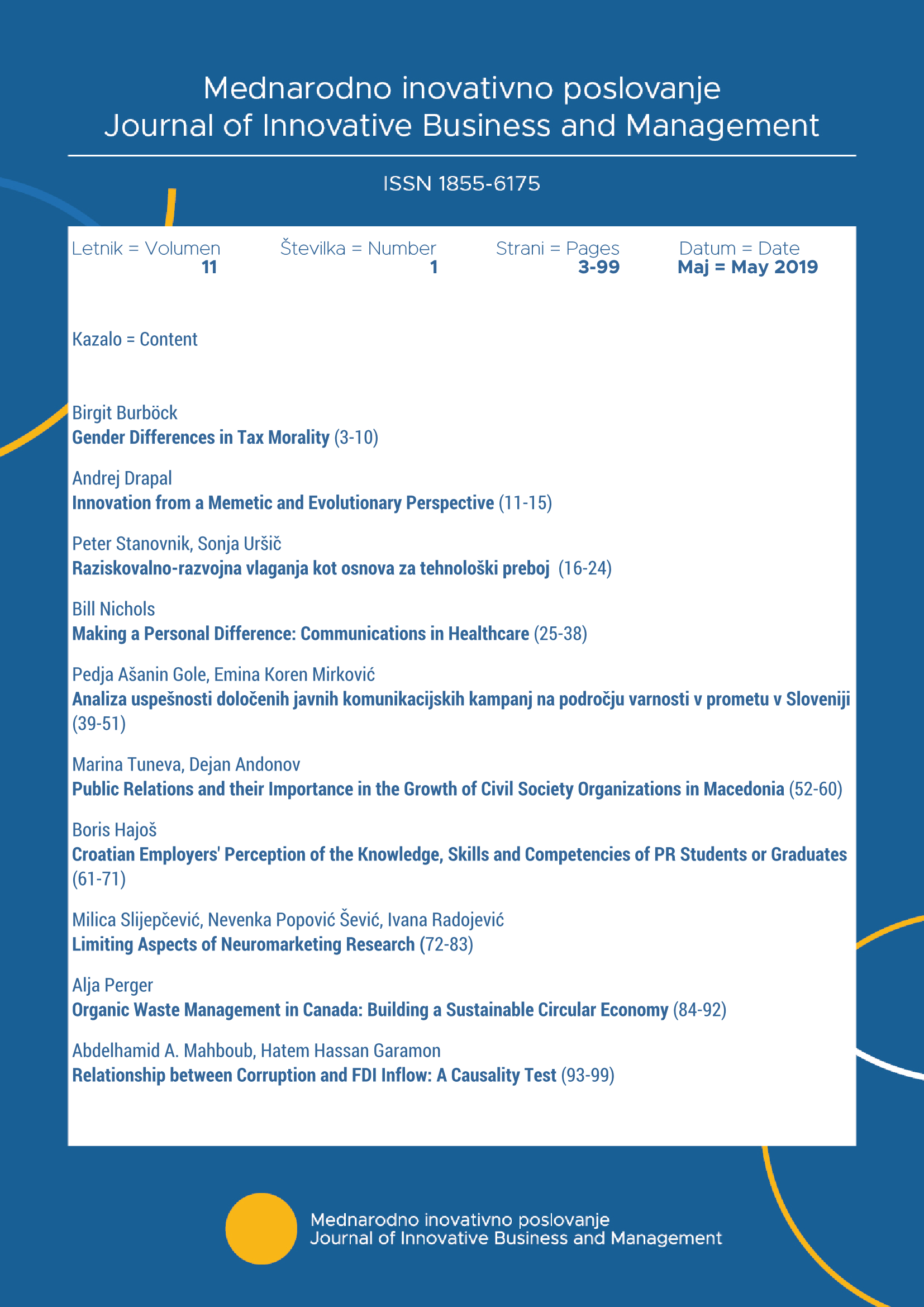
Shadow Economy and Tax Morality: Is There A Difference Between Genders?
DOI:
https://doi.org/10.32015/JIMB/2019-11-1-1Keywords:
shadow economy, slippery slope model, gender differencesAbstract
One of the driving forces of a shadow economy are tax rates and tax morale. The slippery slope framework as a conceptual tool integrates economic and psychological determinants and shows that tax compliance is influenced by (i) trust in authorities and (ii) power of authorities, (iii) voluntary tax compliance, and (iv) enforced tax compliance. Based on the taxpayer’s honesty, the quality of compliance is different. A difference of compliance may occur between gender. We propose insights into possible gender differences with the assumptions of the Slippery Slope Framework with a sample of 656 respondents; 315 male and 341 female respondents. No significant difference between male and female was identified for voluntary tax compliance, while a significant difference was found for the enforced tax compliance.
References
Alm, J., Jackson, B., & McKee, M. (2006). Audit Information Dissemination, Taxpayer Communication, and Compliance Behavior. Andrew Young School of Policy Studies Research Paper No. 06-44.
Alm, J., & Torgler, B. (2006). Culture differences and tax morale in the United States and in Europe. Journal of Economic Psychology 27, 224–246.
Bazart, C., & Pickhardt, M. (2009). Fighting income tax evasion with positive rewards: Experimental evidence. LAMETA, University of Montpellier Working; Papers, 09-01. Available from: http://ideas.repec.org/p/lam/wpaper/09-01.html [accessed: March 15, 2016].
Braithwaite, V. (2003). Dancing with tax authorities: Motivational postures and non-compliant actions. In V. Braithwaite (Ed.), Taxing democracy: Understanding tax avoidance and evasion (pp. 15–39). Aldershot: Ashgate.
Braithwaite, V., & Ahmed, E. (2005). A threat to tax morale: The case of Australian higher education policy. Journal of Economic Psychology 26(4), 523–540.
Buehn, A. & Schneider, F. (2012). Shadow economies around the world: novel insights, accepted knowledge, and new estimates. International Tax Public Finance 19(1), 139-171.
Byrnes, J. P., Miller, D. C., & Schafer, W. D. (1999). Gender differences in risk taking: A meta-analysis. Psychological Bulletin 125, 367–383.
Chung, J., & Trivedi, V. U. (2003). The effect of friendly persuasion and gender on tax compliance behavior. Journal of Business Ethics 47, 133–145.
Cohen, J. (1988). Statistical Power Analysis for Behavioral Sciences. 2nd edn. London & New York: Routledge.
Feige, E. (1990). Defining and Estimating Underground and Informal Economies: The New Institutional Economics Approach. World Development 18(1), 1-29.
Feld, L. P., & Frey, B. S. (2007). Tax compliance as the result of a psychological tax contract: The role of incentives and responsive regulation. Law and Policy 29, 102–120.
Field, A. (2013). Discovering Statistics Using IBM SPSS Statistics. 4th edn. Thousand Oaks: Sage.
Frey, A., & Pommerehne, W. (1984). The Hidden Economy: State and Prospects for Measurement. Zurich, Switzerland.
Gangl, K., Torgler, B., & Kirchler, E. (2016). Patriotism’s Impact on Cooperation with the State: An Experimental Study on Tax Compliance. Political Psychology 37(6), 867-881.
Gerxhani, K. (2007). Explaining gender differences in tax evasion: The case of Tirana, Albania. Feminist Economics 13, 119–155
Gobena, B., & Van Dijke, M. (2016). Power, justice, and trust: A moderated mediation analysis of tax compliance among Ethiopian business owners. Journal of Economic Psychology 52, 24-37.
Kahnemann, D., & Tversky, A. (1979). Prospect Theory: An Analysis of Decision under Risk, Econometrica 47(2), 263-291.
Kastlunger, B., Dressler, S., Kirchler, E., Mittone, L., & Voracek, M. (2010): Sex differences in tax compliances: Differentiating between demographic sex, gender-role orientation, and prenatal masculinization (2D:4D). Journal of Economic Psychology 31(4), 542-552.
Kirchler, E., & Maciejovsky, B. (2001). Tax compliance within the context of gain and loss situations, expected and current asset position, and profession. Journal of Economic Psychology 22, 173–194.
Kirchler, E., Hoelzl, E., & Wahl, I. (2008). Enforced versus voluntary tax compliance: The „slippery slope” framework. Journal of Economic Psychology 29, 210-225.
Kogler, C., Batrancea, L., Nichita, A., Pantya, J., Belianin, A., & Kirchler, E. (2013). Trust and power as determinants of tax compliance: Testing the assumptions of the slippery slope framework in Austria, Hungary, Romania and Russia. Journal of Economic Psychology 34(1), 169-180.
Kramer, R. (1999). Trust and Distrust in Organizations: Emerging Perspectives Enduring Questions. Annual Review of Psychology (50), 569-598.
Lin, M., & Liu, E. (2016). SME’s tax compliance: a matter of trust? Australian Tax Forum 31(3), 527-554.
Luttmer, E., & Singhal, M. (2014). Tax Morale. Journal of Economic Perspectives 28(4), 149-168.
Muehlbacher, S., Hartl, B., & Kirchler, E. (2017). Mental Accounting and Tax Compliance. Public Finance Review 45(1), 118-139.
Muehlbacher, S., Kirchler, E., & Schwarzenberger, H. (2011). Voluntary versus enforced tax compliance: Empirical evidence for the “slippery slope framework”. European Journal of Law and Economics (32), 89-97.
Orsi, R., Raggi, D., & Turino, F. (2014). Size, trend and policy implications of the underground economy. Review of Economic Dynamics 17(3), 417-436.
Orviska, M., & Hudson, J. (2002). Tax evasion, civic duty and the law-abiding citizen. European Journal of Political Economy 19(1), 83–102.
Russell, M. L., Moralejo, D. G., & Burgess, E. D (2000). Paying research subjects: participants’ perspectives. Journal of Medical Ethics 26, 126-130.
Schneider, F. (2015). Outside the State – the Shadow Economy and Shadow Economy Labor Force. Available from: http://www.econ.jku.at/members/Schneider/files/publications/2015/ ShadEcLabForce.pdf [accessed: March 14, 2017]
Schneider, F., & Buehn, A. (2013). Shadow Economies in Highly developed OECD Countries. What are the Driving Forces? Working Paper No. 1317. Linz: Johannes Kepler University of Linz, Department of Economics.
Schneider, F., & Enste, D. (2000). Shadow Economies: Size, Causes, and Consequences. Journal of Economic Literature 38(1), 77-114.
Stensöta, H., Wängnerud, L., & Svensson, R. (2015). Gender and Corruption: The Mediation Power of Institutional Logics. Governance 28(4), 475-496.
Torgler, B. (2003). To evade taxes or not to evade: That is the question. The Journal of Socio-Economics 32, 283–302.
Torgler, B. (2011). Tax Morale and Compliance. Review of Evidence and Case Studies for Europe. Policy Research Working Paper 5922. The World Bank.
Torgler, B., & Murphy, C. (2004). Tax morale in Australia: What shapes it and has it changed over time? CREMA Working Papers Series 2004-04. Center for Research in Economics, Management and the Arts.
Torgler, B., & Schaltegger, C. (2005). Tax Amnesties and Political Participation. Public Finance Review 33, 403-31.
Torgler, B., & Schneider, F. (2004). Does culture influence tax morale? Evidence from different European countries. CREMA Working papers 2004-17. Available from: http://www.crema-research.ch/papers/2004-17.pdf [accessed: March 14, 2018].
Torgler, B., & Valev, N. T. (2006). Women and illegal activities: Gender differences and women’s willingness to comply over time. CREMA Working papers, 2006-15. Available from: http://www.crema-research.ch/papers/2006-15.pdf [accessed: March 14, 2018].
Torgler, B., & Valev, N. (2010). Gender and Public Attitudes toward Corruption and Tax Evasion. Contemporary Economic Policy 28(4), 554-568.
Wenzel, M. (2002). The impact of outcome orientation and justice concerns on tax compliance. The role of taxpayers’ identity. Journal of Applied Psychology 87, 629–645.
Downloads
Published
Issue
Section
License
The authors retain rights under the Creative Commons Attribution 4.0 International License CC BY 4.0. Authors assign copyright or license the publication rights in their articles, including abstracts, to MIP=JIBM. This enables us to ensure full copyright protection and to disseminate the article, and of course MIP=JIBM, to the widest possible readership in electronic format. Authors are themselves responsible for obtaining permission to reproduce copyright material from other sources.