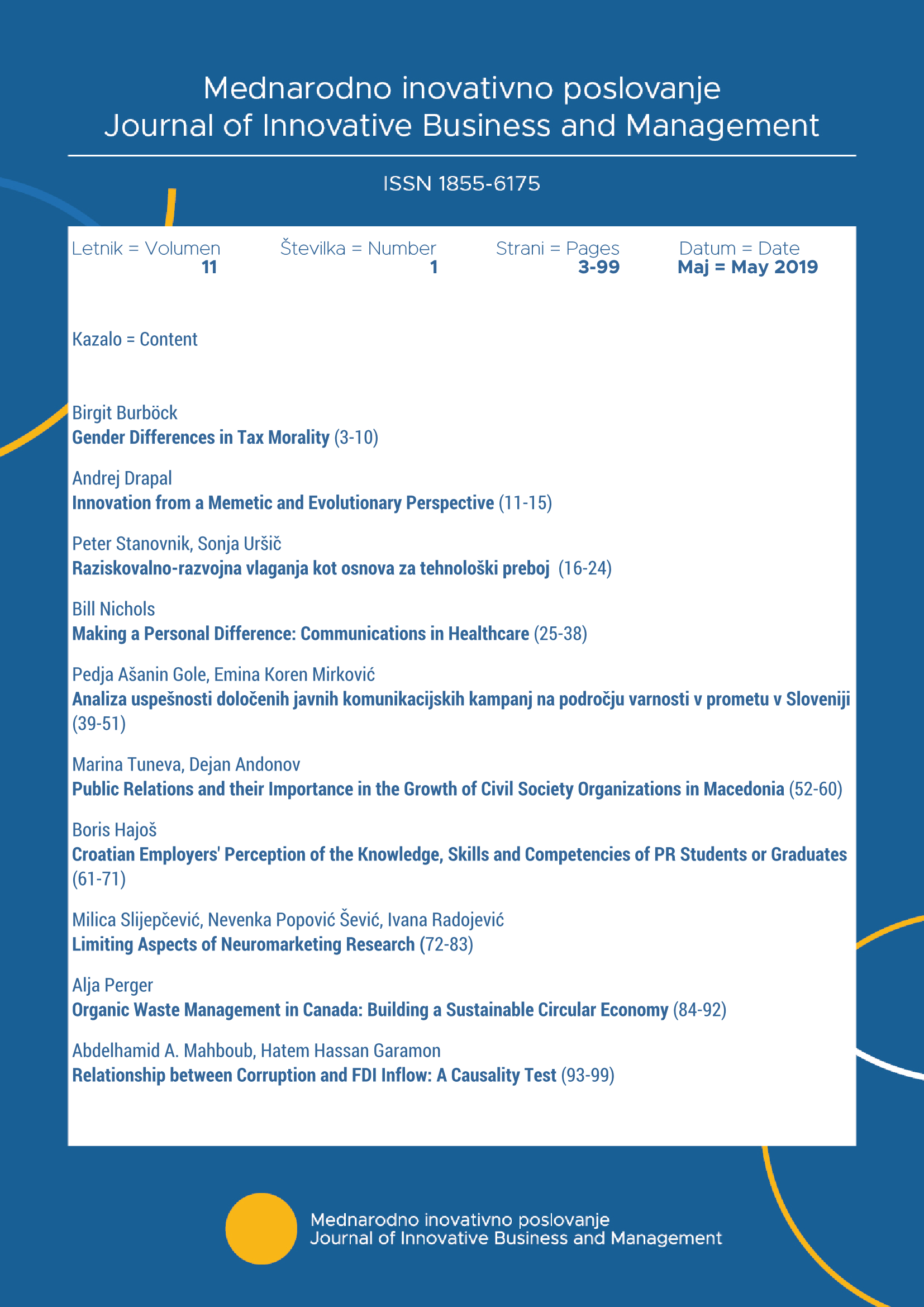
Public Relations and Their Importance in the Growth of Civil Society Organizations in Macedonia
DOI:
https://doi.org/10.32015/JIBM/2019-11-1-6Keywords:
public relations, CSOs, strategic communication, image and reputation buildingAbstract
The article examines the ways in which civil society and citizens can get connected through the communication practices of CSOs. The purpose is to explore how CSOs perceive, organize and coordinate their strategic communication and PR, to identify problems they encountered and to recommend ways of improving their communication practice. The article found out that two-way communication with the public is achieved by organizing different types of events, media relations and online campaigning. Still, there is an insufficient understanding of the importance of strategic communication and ‘ad hoc’ approach is usually used. The reasons are lack of human resources and finances. The implications of these findings are discussed in detail in the article.
References
Albanian Media Institute (2016). Media and civil society in the Western Balkans [e-report]. Tirana: Albanian Media Institute. Available at: http://www.institutemedia.org/Documents/PDF/Media%20and%20Civil%20Society% 20in%20the%20Western%20Balkans-Final.pdf [16. 9. 2018]
Bennett, W. L., & Segerberg, A. (2013). The logic of connective action. Cambridge, UK: Cambridge University Press.
Bob, C. (2005). The marketing of rebellion. Cambridge: Cambridge University Press.
Caroll, W. K., Hackett, R. A. (2006). Democratic media activism through the lens of social movement theory. Media, Culture & Society 28(1), 83-104
CIPR (2012). What is PR?, Chartered Institute of Public Relations. Available at https://www.cipr.co.uk/content/policy/careers-advice/what-pr [1 September 2018]
Dimitrievski, D. (2018) Interviewed by M. Tuneva (2nd September 2018)
Dukerich, J. M. and Carter, S. M. (2000). Distorted Images and Reputation Repair. In M. Schultz, M. J. Hatch and M. H. Larsen (eds), The Expressive Organization: Linking Identity, Reputation and the Corporate Brand. New York: Oxford University Press, pp. 98–112.
Downey, J., Fenton, N. (2003). New media, counter publicity and public sphere. New media and society 5(2), 185-202
Gjilas, D. (2018). Interviewed by D. Andonov (7th September 2018)
Grunig, J.E. and Hunt, T. (1984). Managing Public Relations. New York: Rinehart and Winston
Hallahan, K., Holtzhausen, D., van Ruler, B., Verčič, D. & Sriramesh, K. (2007). Defining Strategic Communication. International Journal of Strategic Communication 1(1), 3-35, DOI: 10.1080/15531180701285244.
ICS (2017). Online Survey: Digital communications in the civil sector in Macedonia. Skopje: Institute of Communication Studies.
Kang, S., & Norton, H. E. (2004). Non-profit organizations use of the World Wide Web: Are they sufficiently fulfilling organizational goals? Public Relations Review 30(3), 279-284.
Karjakov, R. (2018). Interviewed by M. Tuneva (20th August 2018)
Kent, Michael L., and Taylor, M. (1998). Building Dialogic Relationships
Through the World Wide Web. Public Relations Review 24(3), 321-334.
Kent, M., & Taylor, M. (2002). Toward a dialogic theory of public relations. i 28(1), 21-37.
Livingstone S., Markham T. (2008). The contribution of media consumption to civic participation. The British Journal of Sociology 59(2), 351-371. DOI: 10.1111/j.1468-4446.2008.00197.x
Malinovski, D. (2018). Interviewed by D. Andonov (9th September 2018)
Nikodinoska V. (2018). Interviewed by M. Tuneva (1st September 2018)
Pandurska, F. (2018). Interviewed by D. Andonov (7th September 2018)
NN (2018), Interviewed by M. Tuneva (15th August 2018)
Onah, J.O. (2001). Managing Public Relations in the University System: The Nigerian experience. Nigerian Journal of Communications, Nov., pp 23-29.
Rieff, D. (2002). A bed for the night. New York, NY: Simon & Schuster.
Skoric, M., M., Ying, D., Ng, Y., (2009). Bowling Online, Not Alone: Online Social Capital and Political Participation in Singapore. Journal of Computer Mediated Communication 14, 414–433.
Stein, L. (2009). Social movement web use in theory and practice: a content analysis of US movement websites. New Media and Society 11(5), 749-771
Sulejman, D. (2018). Interviewed by M. Tuneva (27th August 2018)
Surman, M. and Reilly, K. (2003). Appropriating the Internet for Social Change: towards the strategic use of networked technologies by transnational civil society organizations. Available at http://www.eldis.org/document/A14411 [27. 11. 2012].
Taylor, Maureen; Kent, Michael L., and White, William J. (2001). How activist
organizations are using the Internet to build relationships. Public Relations Review 27(2001)3, 263-284.
Valenzuela, S., Park, N., and Kee K. F. (2009) Is There Social Capital in a Social Network Site? Facebook Use and College Students’ Life Satisfaction, Trust, and Participation. Journal of Computer-Mediated Communication 14, 875–901. DOI: 10.1111/j.1083-6101.2009.01474.x.
Zuckerman, E. (2004). Using the Internet to determine patterns of foreign coverage. Nieman Reports, 51–53.
Downloads
Published
Issue
Section
License
The authors retain rights under the Creative Commons Attribution 4.0 International License CC BY 4.0. Authors assign copyright or license the publication rights in their articles, including abstracts, to MIP=JIBM. This enables us to ensure full copyright protection and to disseminate the article, and of course MIP=JIBM, to the widest possible readership in electronic format. Authors are themselves responsible for obtaining permission to reproduce copyright material from other sources.